Everything but the Kitchen Sink

Here is a great blog post for those of you who have recently completed your CELTA or Delta course and are about to leave home for your first overseas teaching job!!!

Sandy also suggests “Don’t forget the blu-tak!!!” and you know how much you need that particular substance!!!

Enjoy!

thebestticher's avatarThe Best Ticher

what to pack

I headed abroad to start my first teaching job five years ago, but in many ways it seems like it was only yesterday. Everything was rather a last-minute decision, which resulted in applying for and receiving my visa, purchasing my plane tickets and boarding my first ever flight all in the space of a week. I spent much of that week frantically searching the internet for packing lists, looking to both procrastinate and bolster my own ignorance with someone else’s know-how. After all, how do you pack everything you will need for 9 months of your life into a grand total of two suitcases?

Clothes

Many language schools will have a dress code for teachers, and it’s wise to check this out before you leave. If it isn’t included in your contract or any teachers’ handbook materials you may have been sent, email and ask. First thing’s first, when it…

View original post 1,391 more words

How to Make Things Fall Apart – a PK on Classroom Management


A Pecha Kucha is a short talk based on 20 slides which are self promoted automatically every 20 seconds – so it can last no more than 6’40” . It was created by Japanese architects to relieve the boredom of long talks.

Reposting this from Thomas’ blog

One of my first Pecha Kuchas delivered tongue in cheek in 2011 and created in order to generate a good laugh – but a useful reminder of all the mistakes we have made at one or another time in our lives.  


profesorbaker's avatarProfesorbaker's Worldwide Bilingual Blog

This Pecha Kucha, by Marisa Constantinides, should be required viewing for all EFL teachers. As hilarious as it is, there is a message lurking between the fits of laughter, the mirthful moments, the tears rolling down your cheeks, your sides hurting, as you laugh totally uncontrollably.

If I had an Oscar nomination for, Most Tears of Laughter Cried, or for Most Time Spent Holding Your Sides (because it is so funny it hurts to laugh, but you gotta laugh anyway), well, this Pecha Kucha would win hands down.

And lest we forget, Marisa still manages quite adeptly to touch us inside, where we are reminded, that this is only funny, because…it is true. We’ve all been guilty, from time to time, of the teaching “crimes”, she mentions in the PK.

Yes, in the end, we get a good laugh, and walk away with the firm conviction, to…”not do those things…

View original post 5 more words

Overcoming observation anxiety

Whether you have been observed by colleagues in a more or less unofficial setting, by your DOS as part of a job appraisal scheme or process, or as part of a teacher training course such as the CELTA or the Delta, being observed can be extremely stressful for most teachers.

The topic of classroom observations is very wide but this blog post aims to focus on just one of the aspects involved in the discussion of observations – how to reduce anxiety and feel more confident in order to be able to do your best.

The context outlined below is drawn from experiences of training on or following a training course – a CELTA course or other course at a similar level (or it can be a higher course, such as a Delta or similar); however, job appraisal observations can benefit from the very same suggestions.

Pamellah Hein via Compfight
  Pamellah Hein via Compfight

I am so nervous!!!!

This is a familiar phrase in our CELTA training classroom or our trainees’ preparation room; some suffer more than others, and there are extreme cases when the trainee loses all touch with reality and goes very white and quiet!!!

Anxiety can be of two kinds, debilitative and facilitative and the kind outlined above is not the kind that gets the adrenalin going and puts us into a high energy gear! It’s clearly debilitating and creates panic, loss of orientation and, at times, complete loss of memory!! Trainees forget what they intended to do and with eyes glazed seem to embark on a journey which is quite difficult to comprehend or follow!!!

If you are one of those blessed with a calm and confident personality, stop reading now. Or tell us how you do it. For the rest of us mere mortals, here’s a quick and dirty guide on how to go from terrified to composed in five simple (but by no means easy!) steps.

Be Prepared

Remember that good old boy scout motto? Being prepared in mind and body is very important for any test and any task, so much of this blog post is a reminder of how you can best prepare for a great lesson.

This can be the most important stage for pre-empting potential problems that can quickly turn into sources of anxiety! We’ll call this one the ‘be prepared principle‘ which has a number of important maxims:

1. Clarify your aims

Anxiety is often due to a lack of certainty or clarity of what it is really that we hope to achieve. Do not despair!! This is why you are following this course and not awarded a certificate on day one! There is learning to be done and teaching is a complex, demanding task. Remember these points and try to improve a little in every lesson

  • decide on your primary focus and avoid too many aims
  • be ruthless about leaving out anything not strictly relevant to your main aims
  • write your aims down simply and clearly
  • scrutinise for inconsistencies, tricky points, weak spots.
  • remember not to be over-ambitious as to how much you can fit into your lesson slot. Less is more!!!!

Key words: Be prepared – Clarify your aims – Remove the clutter – Less is more

2. Seek help

Afraid
Juan Pablo Benavente Maturana via Compfight

Teaching Practice points are not cast in stone and tutors usually encourage any creative, innovative or just plain practical ideas you may have in order to achieve your lesson aims.

  • So, talk to your tutor! This should also help alleviate your anxiety, especially since you would be sharing your concerns with the person observing you.
  • Talk to your peers; use them as a sounding board for your ideas. Return the favour; this is a collaborative learning experience after all, and you can benefit from it in three very concrete ways:
    • it takes your mind off your constant worrying about your own lesson plan
    • you can get the most amazing ideas about your lesson as you are considering somebody else’s
    • you are no longer alone in this! The CELTA course (especially the intensive one) was not designed to be a solitary experience. And you will need all the support you can get (and give), if you are to overcome your worries and fears.

Anxiety and fear sometimes spread like wildfire. Avoid contaminating everyone! A group of trainees who are constantly fearful and anxious is not going to be a productive team and it doesn’t look like this feeling can generate the positive energy and enjoyment in the learning which your course should create in you!

Key words: Connect with peers – Ask for support – Do not spread your anxiety – Keep calm

3. Practice makes perfect!

Even very experienced conference speakers tell us how many times they rehearse a talk to make them feel confident. Truly!!!!

Once you have decided what you are going to do, rehearse and time your activities. Enlist a helpful roommate or family member, or one of your peers, as learner substitutes.

If possible, rehearse in front of a mirror or even record yourself giving instructions and asking questions. Pinpoint and amend any potential problems before you encounter them in class! If need be, script your questions and/or instructions. If all this sounds too much, just think of the immediate benefits:

  • you remove a great chunk of uncertainty about how effective your lesson can be, by pre-emptying certain potential problems.
  • you immediately feel more in control of the whole process; this can actively help reduce observation anxiety.
  • you feel more at peace with yourself, because you know you have done your best preparing for your observation.
  • your lesson may not be perfect, but you can get some peace of mind and satisfaction from knowing you have given it your best shot.

If you are worried about not being able to remember your lesson notes, some ideas:

  • print them large (just your own actions) and use colourful and cheerful text highlighters to remind yourself of your next step.
  • put each step on a large flashcard and hold in your hands
  • use a great online tool which works as an autocue – read a short blog post here

Cueprompter
http://www.cueprompter.com/prompter.php


Now, if you are one of those people that tend to express their anxiety verbally, then use this trait to your advantage: find a quiet corner and read through your questions or instructions aloud, concentrating on the language you use.

  • Go into a corner and speak your lines to the wall. The wall will bring back your voice full volume and besides a recording, it’s a great way to hear how you sound.
  • Try to modulate your voice and regulate your breathing. (If you’ve ever had any yoga or meditation classes, now is the time to put everything you’ve learnt into practice). You’ll be surprised how listening to your own voice can calm you, especially if it is clear and modulated.

Key words: Rehearse – Rehearse – Reflect – Revise for confidence

4. Stay ahead of the game

relaxing alfrún
by mararie via Compfight

Do yourself a service and do not leave anything for the last minute.

This simple piece of advice really goes a long way. It means not having to worry about the photocopier or other technology breaking down out of the blue; not rushing around breathlessly to get everything ready at the last minute, among other hurried trainees who are about to be observed too; and allowing yourself a much-needed breathing space to collect your wits and do a few breathing exercises perhaps!
More important even: once preparation is done, and everything is ready, put it away. Stop thinking and worrying about your lesson until about 5 minutes before it is to start. I know this is easier said than done, but here are a few clever tricks to help you along:

  • Remove the whole lesson pack from view: put it in your trainee bag, ready to take with you in the morning; move the digital folder away from your desktop; put away all the reference materials you used. Just don’t lock it in a drawer or hide it under piles of paper: you may forget about it and leave it behind!
  • Deliberately turn your mind to your next project; be it your next assignment due in the following week, writing up your notes from the last input session or just finishing the chapter on listening sub-skills you started on before observation craze set-in.
  • Reward yourself for all your hard work! Preferably with something which will boost your confidence on the actual day.with a new haircut or hairdo
    • a new item of clothing or accessory you’ve always wanted (and is suitable to wear/use in class)
    • an evening out on the cinema or theatre and catch that show you’ve been meaning to see since the course started!
  • Avoid going out with friends and having too much to eat or drink, staying up all night watching your favourite series on a viewing marathon or playing your favourite online-game, and generally anything that saps your energy and prevents you from having a good night’s sleep.
  • If all else fails, exercise till you drop and then go to bed! Just remember to drink lots of fluids.

Key words: Ahead of time – Change scenery – Reward yourself – Rest Body and mind

The self-fulfilling prophecy or….

5. Act confident to Feel Confident

The actual observation day is here, and in a short while, you are about to go into class. Acting confident, even if butterflies are having a rave party in your stomach, is your best ally. Whatever you do,

  • Don’t drive your fellow trainees round the bend by running around like a chicken without a head!!! Remember, they are on the same boat as you and you can work each other up to a frenzy!!! This is a sure-fire way to block yourself (and everyone around you) from doing well.
  • Do not tell everyone (including your students, tutors and support staff) how anxious you feel about this observation and how certain you are that this is going to be a disaster. Repeatedly. Until it becomes a self-fulfilling prophecy.
  • Talk about anything else, or just go for a brisk walk around the block until the urge subsides.
  • Turn your self-fulfilling prophecy into a prediction and a predilection for success. You can do it.
self-fulfilling
Pedro’s self-fulfilling prophecy! Which worked!!!!
  • Do some breathing exercises. A brain without enough oxygen is not going to be much good to you when you need to be alert and going full steam ahead!
  • When it’s time to start, just take a deep breath and smile!
  • Walk into the class room confidently and dive straight into your lesson plan.
  • Smile to your students, look at them in the eye and let the moment sweep you away!
  • Forget your tutor in the corner and concentrate on communicating with your students and listen to what they say. Before you know it, it will be over!

Remember your students – that person in the corner is watching a real teacher teaching real people.

All too often, trainees forget all about the students and teach to and for the tutor/observer.

Not a good idea!!!!

Focusing on your students is a great way to help you forget all about yourself and your own anxiety.

Key Words: Relax – Take a walk – Programme yourself for success – Focus on your students


So, ready for your next observation?


Related blog posts Observation or Presentation Nerves – an #ELTchat Summary

Is the CELTA course just for new teachers?


When the Cambridge CELTA was first created, it was intended as a pre-service course but experience has shown that it is a perfect course for the novice teacher, yes,  but it is also a great course even if you are an experienced teacher who has not had the opportunity to follow a proper training programme.

Here are some quotes from recent course evaluations taken from this page where you can  all 60+ evaluations of our courses.

I have picked some teachers who came to us with considerable teaching experience – I invite you to read the rest of the evaluations if interested.

Often, it is the more experienced teacher who has a lot of trouble adjusting into the discipline and rigour of a course such as the CELTA – not because they cannot process or use the input and tutor advice, but because they have got used to certain ways of doing things in class and, quite often, these habits are very difficult to break.

Vassiliki             

Vassiliki Mantzaris

Vassiliki was a highly experienced teacher when she decided to register on one of our CELTA courses but she was able to adjust very quickly and allowed herself to be open and accepting of new ideas. She is a bilingual teacher with an English mum and Greek dad who is married and lives in Patras. She said:
” It was a wonderful experience for me. I feel that it has really helped me grow as a teacher and made me want to continue growing and becoming better.”

V. Mantzaris, CELTA student, 15 Apr 2015

Vassiliki returned to Patras where she is pursuing a very successful career in what she describes as a ‘great language school’, the Stamatakis School of Foreign Languages. when asked if she found her course useful, she said I still think about the course every single day, as an experience and as a reminder in my daily lesson preparation”

Yusef

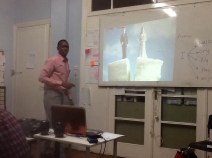
Yusef Turray in action

Yusef was already an experienced teacher from Africa. At the time of his CELTA course, he was teaching in a college in Saudi Arabia. It was great to see him develop new skills and techniques but at the same time retain his great gift for story telling which comes from his heritage. 

The CELTA is not a leveller and does not aim to produce teachers who are replicas of their tutors or behave like copies of British born and bred teachers. It is a great course which allows teachers to develop their special gifts and to adjust their teaching to their particular context and culture.

“The course is an eye-opener and a stepping stone to professionalism in the field of teaching. One won’t regret doing such a course that broadens your chances of excellence.”

Y. Turray, CELTA student, 13 Apr 2015

Yusef continues a great career as an EFL teacher in Saudi Arabia 

 Michelle

“This course is really tough but it really prepares you with a good foundation to start teaching. I’m currently preparing to give my professional exams for my teaching license in the United States and the knowledge from this course is helping me in this area too. Well worth the money and your temporary stress!”

M. Politis, CELTA student, 15 Apr 2015

As a result of the course, Michelle found a teaching job at the American Community Schools and later worked hard and got her teaching licence for the  US. Michelle was a typical example of someone who worked a little bit on the side as a teacher but, in her own words, ‘without really knowing what she was doing”!!!! (I think we have all been there at one or another time in our lives!!!! 

Although she finished with a top grade, it took Michelle almost half the course to get that “Aha!” moment but she did and produced some outstanding lessons in the second half of her course. Sometimes it takes a while to get out of firmly entrenched habits, but the moment when one ‘sees’ is wonderful to watch. 

You can see Michelle in our advert and watch a minute from one of her lessons on the CELTA course.

Here she is in one of her teaching practices –  you can see what a great teacher she is even in one minute! 🙂

Lina

Our last example is a very experienced and well trained teacher who came from a frontistirion experience of teaching English but who had a degree in teaching French as a Foreign Language!!!! Lina was a prime example of someone who made the most out of her course. 

“This course gave me the opportunity to improve my teaching skills and to be able to work abroad which was an unforgettable experience. The tutors were all very helpful and of a high level of professionalism.”   G. Sapounadelli 2013

Lina later became one of the teacher/managers & recruiters for EF English First Schools in the UK.  Here is a great video she made for a lesson – you can download her lesson plan and wonderful materials and view the video she created below

Lina TP 8 Lesson Plan with Xtranormal (lesson plan and materials)

So what are you waiting for? Life is too short to wait to become a good teacher in 5 or 10 years’ time.

As a novice teacher of English, I spent a full academic year working without having received any training – the reasons are of no interest and they are similar to what anyone in the same position might say.

But that year still burns my mind with the guilt of all the things I now know I was doing wrong.

As Costas Gavrielatos says in his paper on “Standards and Development in ELT” (2002) 

Teachers,  however, as providers of a paid service, are fully accountable for the content and process of teaching, and at least partly accountable for its outcome. This is where the analogy breaks down. As a learner client, I’m not concerned with what my teachers’ level will be in a few years; I’m concerned with what it is now.

Reference 

Gavrielatos, C, 2002, Standards and Developments in ELT, ELT News 165, November 2002, p. 11

Do your CELTA with us

Facebook Ad – SPECIAL OFFERb


TEFL Is An Iceberg – Reflections on CELTA and Standards

It was good to find this blog post today – I have been working on a draft of a riposte to many critical blog posts I have been reading recently

James says it all and it is worth a read!

James Taylor's avatarThe Teacher James

Iceberg

When I worked in Costa Rica, my school required teachers to be CELTA or equivalent qualified. They didn’t care where the person was from, whether they were local, a native speaker or a non-native speaker, as long as you had the qualification and experience, then you could work there. To my knowledge, it was the only private language school in the country that had that requirement. The only one. The other schools, and there were quite a few, did not require  the same level of qualifications or experience. Most of them had a preference for native speakers (as I’ve written about here), but qualified teachers were not on their radar. As a result, the school where I worked normally recruited teachers from abroad to come to Costa Rica because, as my DoS once pointed out, all of the qualified teachers living in the country were already working there.

View original post 1,205 more words

Our CELTA pass rate remains steady at 100%

You may wonder how that is possible!

Of course, we are careful to select candidates who have a good potential for success!

Before Each Course

  • We screen them – to find out if they have the required knowledge and ability to analyse language
  • We test them – to see how quickly they can think; our tests are timed and highly reliable
  • We interview them – to check their accuracy and fluency as well as their personal qualities; teachers are not just carriers of knowledge! They need to have the right personal qualities too!
  • We warn them – in case they think four weeks in Greece is going to be a great holiday with afternoons on the beach and evenings at the night club or bar with just enough energy to take oneself to the CELTA session the morning after for a nap :-). It’s hard work! Not a piece of cake!

Which is probably why the CELTA is so highly respected by the industry! CELTA holders know how to plan a lesson with their assigned course book but also without it!

It’s so easy to accept a candidate who hopes to be a teacher of English but who does not have what it takes to pass the course! But accepting everyone makes you a CELTA factory – quite a few of them around – not a quality centre.

Image courtesy of Trickart  http://www.trickartt.com/notes/2014/02/how-my-mind-works-or-the-best-gif-ive-ever-made/

During the Course

Once we have accepted a candidate, s/he becomes our mission for success by raising the bar higher on every single course we run; always looking for better ways to introduce our content, to show our trainees how to be the best teachers they can be, to give them constructive feedback and to help them fulfil their potential for excellence.

Our trainees have outstanding support – tutors, library, online resources and social networking, all in combined synchronicity to inform, to connect, to show them what being a professional teacher is like, to turn them into creative and reflective practitioners, to show them how to keep learning long after their CELTA is over.

Isn’t that the main aim of every educator, to make the learner independent of their teacher? 

After the Course

Since we have refused to be a factory institution, it stands to reason that we have a vested interest in following up our trainees’ progress and development. Today, this is so much easier with social networking tools, that we find our bonds with our  past trainees grow stronger as time goes on.

We follow their triumphs and help with their problems, answer their questions and on occasion, even work with them in new projects, offering them opportunities and opening new doors for them.

It’s also great that we are often invited by them in their new roles and capacities as trainers, directors of studies, writers of materials, managers or coordinators to collaborate with them! This is a fantastic feeling!

Teaching is our passion and we hope this is evident in our writings, in our communication, in our sharing with our community. Our hope is for our trainees to get the necessary knowledge and qualification, yes, but also for some of that passion to rub off so that their pursuit for excellence may begin just as their course ends!

marisa_banner

P.S. You can find out all about our upcoming CELTA courses here

CELTA and Technology – With or Without it?

Leveraging Technology
Giulia Forsythe via Compfight

In a recent end-of-course evaluation report,  one of our CELTA candidates suggested (complained is perhaps a better word) that her expectations of a higher grade on the CELTA course were not fulfilled because she did not know how to use technology. Had she not been encouraged to use it (by her tutor), she said,  she would have achieved a higher grade. It was the effort she put into including tech in her lessons that which cost her this higher grade.

For this trainee (now teacher), learning to use simple tools such as powerpoint, projecting images and slides on the data projector, or showing a You Tube video in her lessons, was perceived to be a  task which took up  so much effort, that her performance suffered and so the highly desired Pass A or B was not achieved.

Learning to…

  • plan lessons
  • design handouts
  • create role cards
  • design information gaps or games
  • specify lesson aims
  • achieve lesson aims
  • find and adapt suitable activities
  • etc etc.

….these were nIMG_3537ot perceived as difficult or as demanding as plugging in the data projector and hooking it to your laptop to project a simple word handout or powerpoint.

All these things were perceived as normal but knowing how to use a few  simple tools like those mentioned above, or a word cloud  was not.

In fact, using technology was perceived as not only unnecessary, but as a block to achieving the learning of all these complex tasks, an added pain even which put a stop to that trainee’s progress.

Blocks to technology

Typically, those who resist technology and express similar views are older candidates who have some or a lot of experience of chalk and talk (or board marker and talk, if yoIMG_1982u like).  Some younger candidates though can also be staunch resisters. Our philosophy of teaching and educational values often comes from being a learner and many of these teachers come from a highly teacher-centred educational framework of chalk and talk, of grammar translation, of teachers untrained and uneducated in terms of pedagogy studies.

Educational values are unconsciously acquired, even if our conscious mind never found any pleasure in learning in such situations.

One of these trainees even went as far as to tell us that we should be warning people on our website that obtaining the CELTA involves knowledge of technology (it doesn’t). Knowing how to use Word and Powerpoint is not real tech or part of a teacher’s 21st century skills toolkit.

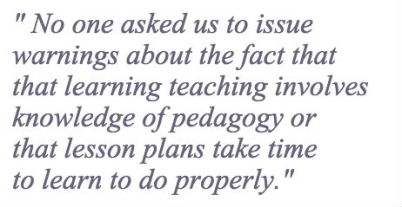
No one asked us to issue warnings about the fact that that learning teaching involves knowledge of pedagogy or that lesson plans take time to learn to do properly.
quote3So why is it that some people think they actually can put us to task for not having warned them about the use of educational technology?

Surely, pedagogy is much more complex as a field than knowing how to use some simple apps or tools,
but there you have it in a nutshell: using technology raises the hackles of some people.

We tend to call such people technophobes and may be we have all gone through a stage like this at some point in our lives.

But we managed to overcome our fear; some of us even jumped right in without any fear even but with excitement about the new learning opportunities and the chance to do an even better job.

This is not to say that we do not acknowledge the learning effort though we do wonder when it raises such obstacles and such strong emotions.

Without Technology?

Of course we have seen ( and still see and teach) some absolutely wonderful lessons which did not use any of the latest technology or apps, not even a powerpoint or typed and colour printed handouquote2ts!  I have some such lesson plans in storage and keep them in awe of the artwork that has gone into them
But the professional effect achieved took the trainee teacher numerous hours of hand-drawn artwork – such as all of us have done at one time or another.

I have drawn numerous flashcards myself and still remember the time that went into creating them. And I do also remember the pleasure I got out of doing them. So may be some people do get their kicks out of creating their own hand -crafted materials and that is fantastic. There is no reason to stop doing that if you have the time and the will to do it.

Does technology stop us from doing that? Of course not! But when we don’t have the time to indulge in such pleasurable handiwork for our classes, it’s there to help us produce professional and neat looking materials that will also be visually pleasant and memorable for our learners.

Incidentally, would this trainee complain had she had to do handwritten and hand-drawn materials and handouts? Would she have then blamed the lack of technology for her grade? I am curious.

With or without?

Saying swimming sucks because you can’t float is not just narrow minded, it’s also not very clever. But phobias of this or that – technology in our case – are not always backed up by intelligent reasoning; they exist because of the strong emotions they generate in individuals, their lack of self-esteem and the blocks they themselves have created which say things like “I am not good/clever/old enough to learn how to use this technology because it would take me forever” or “I can’t be bothered to learn this technology because it might make me look incompetent or I would rather not spend time learning it”.

quote1

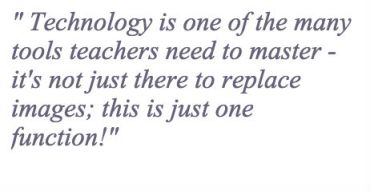
Technology, after all, is just a range of additional tools but it is not the answer to every teaching or learning problem.

Ignoring it or resisting it, however, will not be an option for long; teachers who cannot use it will eventually be phased out by teachers who do use it as it provides us with numerous learning tools that go far beyond a nice looking image, so resisting learning about or using what is available limits learning opportunities for our learners.

It’s not just there to replace images; this is just one function!

More importantly, the decision to use or not to use technology is one that you can only make if/when you can use it, not when you can’t!

As I write these lines in the year 2015, I am thinking of all the impassioned discussions between technophiles and self-proclaimed luddites back in 2009  and 2010. You might not think that 5 years is not a long time but, actually, in tech and web culture terms, it is!

I didn’t think such attitudes would still be going strong today but, there you have it; the same issues need to be addressed and re-articulated in new ways, to catch the latest batch of digital resisters 🙂

With Technology but for a good reason

The Cambridge syllabus stipulates that courses should include
IMG_3740The selection, adaptation and evaluation of materials and resources in planning (including computer and other technology based resources) (4.4)

Technology has been a part of the syllabus for a long time, although it is true that many centres still opt not to train their candidates in its uses for the same reasons that trainees resist it: ignorance, lack of confidence, lack of conviction in its educational value and just plain shirking one’s duty as a trainer – in the same way that some teachers shirk their duty as teachers.

I feel this an opportunity lost for ever – given the funds, effort and energy one puts into this qualification, surely, they would want to be taught all the required components of their syllabus!

This could go round in circles for ever. I think I will just close with a great aphorism – widely quoted but of uncertain origin – which epitomises the spirit of this post as well as why we believe in making educational uses of technology an integral part of all our teacher courses – including the CELTA.

Technology won’t replace teachers, but teachers who use technology will probably replace teachers who don’t. 

.Power User

Alec Couros via Compfight

It’s inevitable and we cannot go back. We can choose to have lessons or activities without tech but this, also, must be a considered option not a random decision or a non-decision.

Related Posts  

The CELTA Handbook  

N.B. All photos w/o attributions by Marisa Constantinides  

CELTA interview series- Michelle Smith Politis – an American in Greece

Michelle Smith Politis is from Wisconsin, US but she married a Greek and moved to Athens about 15 years ago.

  She is a mother of two – because of her children who are still very young, she chose to follow our part-time option. 

Michelle holds a BA in International Relations and by now, she has been working as an EFL teacher in Athens for 5 years.

In many ways, she represents the typical native speaker who finds it easy to get jobs because of her native speaker status. Of course, she also has great personal charm and is a great communicator, but when she started, she was not properly qualified to teach English.  

To her credit,  once her children were a little older and she could find some time while they were at school, she decided to take a proper course in order to learn more about the pedagogy of teaching English. 

Here are the questions we asked her;  we hope you will find Michelle’s answers interesting. 

1. What made you decide to follow the CELTA course?

Before taking this course, I had three years of teaching experience with adults and young learners in private language schools in Greece. However, before I even got to Greece my background was in finance management. I decided to pursue the CELTA as I soon realised that just because I am a native speaker it isn’t always so easy to teach the English language.

2. What were your expectations of the course? Were they met?

My expectations were many! I needed to learn how to plan a proper lesson and to exploit the lessons in the coursebooks further.

I wanted to learn how to improve upon them and make them more communicative.

I also needed help in analysing grammar to prepare for any questions that could come up in a lesson.

I really wanted a way to make grammar lessons fun and memorable.

This course met all my expectations and more!

3. What was the most demanding aspect of the course?

The most de2013-11-19 13.34.34manding part of the course for me was probably the four written assignments we needed to do. Writing those assignments and preparing creative lessons was a true lesson in time management!

In the end, it all went well and I made it through. The most important lesson I learned was to stay calm and keep on going.

4. Any tips for prospective CELTA candidates?

The most important advice I would give to any future CELTA candidate would be to just relax and enjoy the course. Be open to constructive criticism and try not to take everything so seriously. Your tutors are there to guide you through the whole process and are your safety net.

5. Many people say that what you learn on the CELTA is impossible to use in ‘real classes’ . Your thoughts on this?

In the end, it’s up to you how you decide to move forward after your course. You may decide you want to plan less for your lessons, or even perhaps more. All this is up to you.

Everything you learn will definitely be put to practice over and over as you gain experience in your teaching.

This is a very practical course that prepares you to teach confidently in your classroom.

Make the most of the experience. Good luck!

Michelle Smith Politis

After her course, which she passed with flying colours, Michelle started blogging, first of all in this very blog and later, it was great to see her create her very own teaching blog!

Here are a couple of posts she wrote on this blog:

Both these blog posts include videos of Michelle teaching one of her final lessons in which she got her students to write some pretty poignant lyrics for a country song –  I shall let you guess her language aims by watching that video!!!

You can follow her on Facebook,  Linked In, Twitter and Pinterest – Michelle is already a well connected teacher indeed!!!!

 Since March 2014, she has been a Substitute Teacher at the American Community Schools of Athens and continues to offer private tutoring in English. 


CELTA Interview Series – Iman Vahdati Dovom – a teacher from Iran

Last May CELT was ‘taken over’ by a group of trainees from Iran – they captivated all at CELT, tutors and colleagues alike and we all loved the great mix of Greek and Iranian candidates with a couple of other nationalities thrown in !!! 

Sometimes it’s hard for us to imagine the teaching conditions in a country and setting other than our own. One of the great benefits of training on a CELTA course is meeting so many people from other countries, other mindsets and, sometimes, completely different education cultures.  The sharing and learning that takes place is that much more enhanced as well by watching teachers with different teaching styles and who come from such diverse backgrounds. 

The learning is not just by the trainees but by the tutors as well and this group was a prime example of a great learning group for all parties concerned.

 Iman Vahdati Dovom

PhotoFunia-iman

Iman is 29 years old and hisw home town is Tehran. He came to Athens with 5 years’ teaching experience under his belt and an MA in TEFL.

So this was no novice to ELT, nor a teacher who was unaware of the principles or practices in current English Language teaching, so it was interesting for us to find out why he opted to do the CELTA course AFTER his M.A.!!!!

1. What made you decide to follow a CELTA course?

I was familiar with different pedagogical theories prior to the course. To me, many of these theories were too obscure to put into practice; so, I decided to do the CELTA since I considered it to be a change for the better.

Snapping out of the traditional teaching mode and getting the inspiration from candidates from other parts of the world added to my overall motivation.

So, at the suggestion of my boss, I took the course without hesitation.

2. What were your expectations of the course? Were they met?

Receiving loads of support, illuminating grey areas in ELT, providing blanket solutions to practical problems, careful assessment, reflecting on what I did before, during, and after lessons, were my expectations to name but a few.

Another expectation was that hoping to ‘see’ what factors may prevent learning from taking place. Basically, I needed to learn how to break the vicious circle of teacher-fronted lessons.

Many of those expectations were met and I consider the course as a stepping stone to success.

3. In your experience, what is the most demanding aspect of the course and why?

The most backbreaking part of the course was its intense nature. I could not sleep for many nights in a row and that affected my performance on the course quite a lot.

4. What tips would you give prospective CELTA candidates concerning the course?

Get ready for sleepless nights and rough days; brace yourselves for stressful situations! And remember: there is no rough and ready rule to overcome this.

Pay attention to the academic aspect of the course as well. What should be borne in mind is that the course might have a deep-seated influence; especially, for those who do their best and want a change; it is worth the pain and pressure!

5. It is widely believed that what candidates learn on the course cannot be put into practice in the ‘real world’ (sic). In your experience, how true do you think that might be?

I should say I agree to some extent since many of those ideas are not culturally easy to adopt in every country of the world or with every age group.

Another issue is that the different personalities  of the students are not taken into account either; so, much of what we learnt on the course was a basis of general rules and tasks which are not tailored for different learners.

It’s also true that I have not been able to plan in such meticulous detail! I have to teach many classes everyday and this kind of preparation is really time-consuming.

But knowing these techniques, aside from having learnt how to do a needs analysis for my learners, is vitally important to me now.  I feel much more confident using them!

I believe that putting what we learnt into practice depends very much on each individual’s creativity and imagination.

Thanks to the CELTA course, I have learned some new ways of building bridges between my theoretical knowledge to the actual teaching.

The CELTA course taught me to reflect on what I do – this is another area that I was introduced to on the course and I have been mainly focusing on it since then to keep developing and improving myself as an ELT teacher.

 Iman Vahdatti Dovom

iman_G
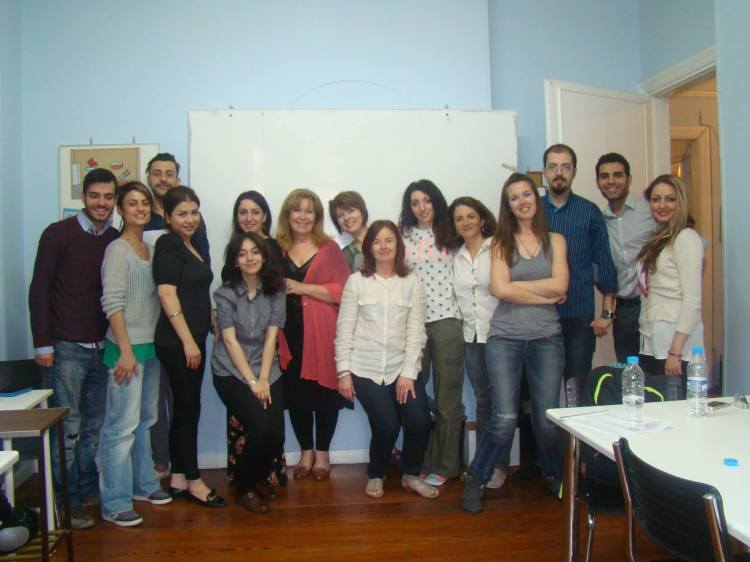
May 2014 group of CELTA trainees on the last day of their course. Iman is in middle in the last row.

Many thanks to Iman  for his candid comments. Despite his belief that his performance was affected by the sleepless nights, he managed to leave the course with the highest of grades.  On completing his course, Iman returned to his job as an ELT teacher at Hermes Institute in Teheran. 

Our next interview will be of a teacher from the US who also completed her course in 2014 at CELT.

(Images by Marisa Constantinides & Angelos Bollas)

iman_C

Postscript

A couple of comments about Iman in the social media – quiet people make less noise but leave lasting impressions 🙂

Angelos Bollas on Twitter    Marisa_C What a great month was that  And what a great guy      wordpressdotcom

Bita's-comment-


CELTA Interview Series – Mado Lambropoulou – a teacher from Greece

A course like the CELTA may have a public syllabus which is open to scrutiny but teachers, whether experienced or new,  following this course take different things from it.  

We thought it would be a good idea to share some of these individual perspectives with our blog readers so this is the first of a series of posts.

Some people follow the CELTA to change their career, some to obtain a formal qualification, others in order to feel more confident about their teaching in the classroom.  But no matter why they follow it, they find themselves in the role of a learner on a demanding course.

We decided to ask everyone the same interview questions for this new series of blog posts but, of course, they were free to answer in any way they liked and to add any facts or opinions which they thought were important to share.

We hope you find this series useful. Our first guest came to the course with 15 years of experience under her belt!!!!!!

Mado Lambropoulou

Mado

Mado is a teacher from Greece; she’s in her 30’s and joined our intensive CELTA course last summer after 15 years of teaching experience without any prior formal training.

Mado studied Political Science and Public Administration at the National and  Kapodistrian University of Athens but, being unable to find work,  she got herself a  C2 certificate in English and a teaching licence; this allows people to work as ELT teachers in Greece ever if they do not have a related degree (or no degree at all), but only in private language centres.(1)

Mado is married and a mother of one.

Here are our questions to Mado.

1. What made you decide to follow the CELTA?

First, I needed a certificate in ELT and the CELTA course seemed to be the best option; second, I needed to know if what I had been doing all those years was right – or wrong!

2. Your expectations of the course? 

Before starting the intensive CELTA course, I had read almost everything there was to read on the internet: official pages, blogposts, discussions in ELT forums, etc. Everyone mentioned how demanding the course was and that in order for a trainee to benefit from it, they would have to be open-minded and ready to change everything in the way they had been teaching. I was terrified and excited at the same time; my expectations therefore were quite high.

I expected it to be a unique, exhausting, almost mind-blowing experience that would totally transform me as an EFL teacher – and that was exactly what it was!

3.  What was the most demanding thing on the course?

I saw what I had got myself into on day one!

b0ebcb488b44487d7af3d1559a97b412

The input sessions, getting your lesson plans ready on time, gathering information for the assignments, being in the same place with 20 absolute strangers for 8 hours – everything seemed too much! As the days went by, however, everything became much smoother.

The input sessions were an excellent opportunity to gain valuable knowledge from the tutors and fellow trainees from all over the world; the lesson plans and the assignments gradually started to make sense; the strangers became my good friends who had been going through the exact same difficulties.

The only thing that remained a real challenge throughout the course, though, was the necessity to put newly-acquired knowledge into practice almost immediately.

4. Tips for prospective CELTA candidates?

Since the course ended, I have spent quite some time reflecting on it. It has been a worthwhile experience, which I would have probably been incapable of completing if I had not followed my own “set of rules” :

_________________________________________________________________
• Listen to your tutors! They will do everything in their power to help and prepare you.
• Organise your reading beforehand. It is almost impossible to do any serious studying once the intensive course begins.
• Organise your time accordingly. Leaving things for the last minute will only stress you out even more.
• Be open to feedback and respond to it. This is probably one of the reasons why you might choose this course.
• Eat, sleep, and spend time with your loved ones. Reboot before starting any task!
• Enjoy every minute of it!

5. Many people say that what you learn on the CELTA is impossible to use in ‘real classes’ . Your thoughts on this?

Since I finished the CELTA course, it has been impossible to teach the way I used to.

It has not always been easy as I have had to deal with untrained employers and colleagues and comments like this do usually come from them.

However, I believe that once you have made such a huge effort, you owe it to yourself to continue developing; and you will soon find out that you are not alone in this.

There are countless students, colleagues, and employers out there seeking innovative ideas, inspiring suggestions, and teachers willing to work and think out of the box.

Mado Lambropoulou

Postscript

Many thanks to Mado for this first piece. She was certainly able to think out of the box herself and despite the challenges, she  passed her course with flying colours and left  with a Grade A!!! Congratulations are due! Once Mado completed her CELTA, she found a teaching job at the local British Council as a teacher on their Young Learner courses. 

Our next interview will be of a teacher in Iran who also completed his course in 2014 at CELT.

(1) Being able to work with a C2 qualification is unique to Greece and has been happening for more than one cares to remember; currently, this is a law which is under revision and which will mean that C2 holders will not be allowed to do this any longer.

(Images of adult learners at CELT by Marisa Constantinides)


Do your CELTA with us

cropped-celtfacebookheader.jpg