

This short guide is by no-means comprehensive, but I do hope it is practical and to-the-point. It is based on my experience as a CELTA trainer, so one might say I have seen the course form the inside J So here goes!
What is the CELTA?
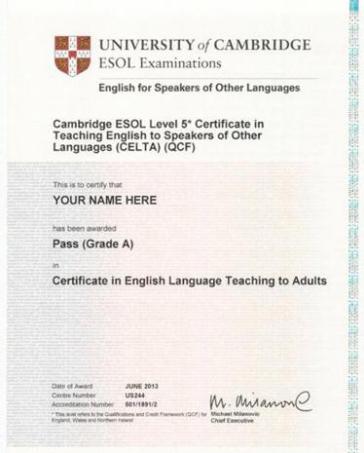
The Certificate in Teaching English to Speakers of Other Languages formerly ‘Certificate in English Language Teaching to Adults’ (CELTA, /seltə/) is an initial credential ( pre-service qualification) for teachers of English as a foreign language, a well known requirement for those entering the field of English language teaching. Since it is recognised internationally, it is a particularly popular credential among both new teachers as well as amongst more experienced colleagues, who see it as a passport to teaching English around the world or locally.
(adapted from WIkipedia)
It’s both a journey and a destination!
Photo Credit: Justin Brown via Compfight
More than 10,000 candidates follow CELTA courses successfully every year. The CELTA is not the end of the road, of course; it’s the beginning of a great journey with the goal of becoming a great ELT teacher!
Who can do it
Anyone with a good knowledge of the English language, at C1 or preferably C2 level, be they a practising language teacher or an aspiring one can apply for the CELTA. Ideally, a candidate should be over 20 years of age.
Anyone with those pre-requisites can, potentially, be accepted on a course. But do remember:
- You also need to do well on the language assessment set to you by the course provider
- Your spoken English must be at a level appropriate to teaching a variety of levels
- Your knowledge of grammar and ability to explain language should be at a good level
- You must be healthy and of sound mind!
- You must prove to your interviewer that you are ready to commit to the demands of the course
- You must provide evidence that you are potentially a successful CELTA candidate
Do bear in mind that teaching is a demanding but rewarding profession. If you are prepared to work hard, be a lifelong learner and commit to the idea that it takes time to become a great teacher, then the CELTA is a perfect choice for you. With this qualification, you will have many more opportunities for career development than with other, non-recognised, qualifications.
Once you are accepted, there is more work to do!
To find our how you can face some of the demands of the course, we have prepared some tips listed below, based on our experiences of having worked with numerous CELTA trainees since 2006.
Some Do’s and Dont’s
Do’s
Don’ts
- Decide whether the part time or the full time option is the best choice for you.
- Automatically assume that there is only one option: the full-time, intensive course.
- Take into account that intensive courses are demanding and not ideal for everyone’s learning pace & style. Choose this option if you thrive on pressure!
- Follow the course if you are going through a hard time in your personal life; this affects concentration and performance.
- Allow adequate preparation time. Your centre will provide you with a pre-course task, a series of exercises to prepare you and to get you to do some background reading. Do this systematically and thoroughly.
- Rush through the pre-course task, giving short, superficial answers to the questions posed; the task is not a test, it’s a reflection and learning tool.
- Do some background, preparation reading before the course; try to read at least two or three of the books suggested in the pre-course task.
- Avoid doing any background reading because you think you will have time to do this later during your course. This is usually not the case!
- Revise your formal knowledge of grammar; your tutors may have made some suggestions when interviewing you; follow them. Read at least two or three good grammar books, including Scott Thornbury’s ‘About Language’.
- Assume you know it all, either because you are native speaker or because you studied grammar as a learner. A teacher needs a higher level of expertise; intuition or information passed on to learners is not enough.
- Be very clear as to what is expected from you on a CELTA course. Download and read the CELTA handbook very carefully so that you can understand the course objectives and course expectations.
- Think that there will be time for you to do that later. There won’t! You will need all your time to plan lessons and design great activities!
- Download and read the CELTA 5 Candidate Record Booklet and any other orientation material your centre provides, e.g. a trainee guide. This will be your constant companion during the course and the assessor will examine it for evidence of good performance.
- Neglect this opportunity to be well-informed and well-prepared; neglect to learn the rules and how to maintain your CELTA 5 in top condition, so as to give the external assessor the best impression about your potential as an ELT professional.
- Map out your study schedule for CELTA work: if possible, clear your schedule of other activities during CELTA days and allot specific time slots for your lesson preparation and course study.
- Not even for one moment should you imagine that this is something you can breeze through without being organised and prepared to work really hard, especially if following the full-time option.
- Approach the course with an open mind. This is a personal and professional development experience. Be prepared to reflect and experiment with all new ideas!
- Block new ideas and approaches to teaching because they do not fit in with either how you learnt the language or how you have been teaching (if experienced).
- Be ready to interact and participate actively, to contribute as much as you can to the sessions, seminars and workshops. Be willing to share your experiences, your knowledge and your reading!
- Expect the course to be a series of lectures, followed by memorising content and a final exam. This is a highly participatory course and your tutors will practice what they preach!
- Be prepared to be observed by other teachers and, of course, your tutors. Take deep breaths and light exercise like a good athlete before a race!
- Be surprised if you feel nervous or shy, even if this is not your usual attitude: it is absolutely normal and usually soon overcome.
- Brace yourself for the high value of critiquing lessons and learning from your mistakes. Teaching Practice and feedback on your teaching is the most useful aspect of the course!
- Expect to be praised or feel that you are a failure if your tutors or fellow trainees offer critical comments. Oversensitivity to feedback never produced excellent teachers!
- Be prepared to observe other teachers teach, look at their lessons critically and offer objective, constructive feedback. Understand that these lessons will contain mistakes; treat them as learning opportunities
- Be subjective and personal in your peer assessment: you will not help your colleagues this way, nor yourself. We learn valuable lessons even when we observe someone make mistakes.
- Take the feedback provided in the spirit it is offered – to help you reach your full potential as a teacher.
- Assume that negative comments imply that your tutors or your fellow trainees do not like you.
- Do your very best every step of the way and avoid worrying about grades.
- Obsess about grades! Some of the best teachers and teacher trainers started with a standard PASS.
- Take risks and try out new things, new ideas that you have learnt in your input sessions.
- Expect to stay in your comfort zone and do the bare minimum to scrape through.
- Pace yourself: your study schedule should allow for some “me time”, essential to unwind and recharge your batteries.
- Devote every waking minute to your CELTA studies, stay up all night, eating badly, depriving yourself of sleep; you need your energy!
- Collaborate well with all your fellow trainees be they less or more experienced than you, be they more or less proficient in the English language than yourself. The bonds you create during your course will last you for a long time and are the beginning of your PLN (Personal Learning Network)
- Be a lone wolf, someone who discourages collaboration and sharing of ideas with others. Learning is a social activity and we learn better together. Avoiding others will rob you of the opportunity to experience collaborative learning – something your course hopes to teach you to be able to do.
- Enjoy your course! Rest assured that, even if you think you are suffering and you believe it’s hard, once finished, you will remember even the hardest moments with a great nostalgia, as many of our trainees so far have proved! It’s the experience of a lifetime!
- Keep complaining about the work load, your grades, other people’s comments, the students who are not responding to you in the perfect way you thought they would! Moaning and groaning never got anyone anywhere near the energy and enthusiasm needed for great results!
Haven’t discouraged you?
Join the good race, then, and happy TEFLing!
More advice
If you need more information and advice, here are two possible websites to browse through.
The official Cambridge English website
The CELT Athens Cambridge CELTA Wiki
Do your CELTA & DELTA with us


 This short guide is by no-means comprehensive, but I do hope it is practical and to-the-point. It is based on my experience as a CELTA trainer, so one might say I have seen the course form the inside J So here goes!
What is the CELTA?
The Certificate in Teaching English to Speakers of Other Languages formerly ‘Certificate in English Language Teaching to Adults’ (CELTA, /seltə/) is an initial credential ( pre-service qualification) for teachers of English as a foreign language, a well known requirement for those entering the field of English language teaching. Since it is recognised internationally, it is a particularly popular credential among both new teachers as well as amongst more experienced colleagues who see it as a passport to teaching English around the world as well as amongst teachers who teach locally.
(adapted from WIkipedia) …
View original post 1,322 more words







 The Cambridge CELTA