Preparing for your CELTA (Certificate in Teaching English to Speakers of Other Languages)interview is crucial to making a strong impression and securing your spot on the course. Here’s a step-by-step guide to help you get ready:
1. Understand the CELTA Interview Structure. which typically consists of:
A discussion of your background and motivation (Why CELTA? Why teaching?)
A language awareness task (grammar/vocabulary questions)
A written pre-interview task (often sent in advance)
A teaching-related discussion (e.g., classroom management, learner needs)
2. Review Basic English Grammar
You will quite likely be tested on:
Parts of speech (verbs, nouns, adjectives, adverbs, etc.)
Tenses (present simple vs. continuous, past perfect, etc.)
Phrasal verbs, modal verbs, and conditionals
Common learner errors (e.g., “I am agree” → “I agree”)
📌 Tip: Brush up using resources like “Practical English Usage” by Michael Swan or online grammar quizzes.
3. Prepare for the Written Task
If you received a pre-interview task, ensure you:
Answer thoroughly and accurately.
Proofread for grammar/spelling mistakes.
Be ready to discuss your answers during the interview.
4. Reflect on Your Teaching Motivation
Expect questions like:
Why do you want to teach English?
Why choose CELTA over other certifications?
What challenges do you expect, and how will you handle them?
Have you had any teaching experience (even informal)?
📌 Tip: Show enthusiasm, adaptability, and awareness of learner-centered teaching.
5. Demonstrate Awareness of Teaching Skills (not required but you might be asked)
You might be asked to comments on:
Classroom management (e.g., dealing with mixed-level students)
Error correction (when and how to correct mistakes)
Engaging different learner types (visual, auditory, kinesthetic)
6. Ask Thoughtful Questions
Prepare 2-3 questions to show your interest, such as:
“What support is available for trainees during the course?”
“How is feedback given on teaching practice?”
“What percentage of trainees typically pass the course?”
7. Dress Professionally & Be Punctual
For in-person interviews: Business casual is fine.
For online interviews: Ensure good lighting, a quiet space, and a stable connection.
8. Mock Interview Practice
Practice explaining grammar points simply (e.g., “What’s the difference between present perfectand past simple?”).
Rehearse answers to common questions (e.g., strengths/weaknesses as a teacher).
Final Tips
✅ Be honest – If you don’t know something, say so but show willingness to learn. ✅ Stay calm – The interviewer wants to see your potential, not perfection. ✅ Show enthusiasm – CELTA is intensive, so they want motivated candidates. ✅ If the course is online – the interviewer will also want to make sure you are familiar with some elements of technology and you are not a beginner who is frightened by the use of online tools and applications. After all, Teaching Practices are going to be on Zoom on an online course!!!!
Different centres follow different scenarios in their interviews but what they need to find out about you during the interview is not just what you have written in your application form or CV.
Your interviewer may wish to doublecheck all or some of the following – whether you are a native or non-native speaker of English:
that your knowledge of grammar and vocabulary is in place
that your spoken English is at a high enough level
that you have good personal communication skills
that you have an awareness of the demands of the course
that you are not going through a difficult time in your life which might prevent you from being successful on the course
that you are open to learning and amenable to criticism as the course is high on critique of one’s teaching
that you are well-organised and disciplined
that you do not have any biases which might prevent you from offering equal opportunities to your learners
Your interviewer – who will usually be a CELTA tutor – will also give you a lot of information about the course, the number of assignments, teaching practices, about the workload and the resources available. Feel free to ask any questions which will help you understand how to organise your study time so that you can maximise your chances of success.
At some point during the interview, some centres might also ask you to do a quick writing task – something related to language or teaching which should take no longer than 10-15 minutes. This might be done in order to see if you can express yourself clearly, correctly and fluently when you have to write under pressure as some centres will not time you while doing the pre-interview task.
Above all, the interviewer will want to see if you
are aware that teaching is a demanding profession,
have very high or very low expectations of yourself,
have the kind of personality that will allow you work well with others in your group (trainees collaborate in Teaching Practice groups)
have an understanding of what it takes to be a teacher.
So, all in all, being accepted on a CELTA course can be a great thing but if you are not accepted, this will usually be done because the interviewer believes that at this particular stage, your chances of being a successful candidate are not very high – which not a bad thing, as following a CELTA course involves a great commitment of time, money and personal work during course hours and after hours too!
Having an idea of what it is that centres look for may help you prepare better and be accepted next time round.
When we think about the role of a CELTA tutor, certain words immediately spring to mind: trainer, teacher, assessor, observer. These are all accurate and important descriptors.
But one role that often goes unspoken, and perhaps undervalued, is that of advocate. The CELTA tutor is not only someone who assesses a trainee’s performance against a set of criteria, but someone who actively roots for their progress, believes in their potential, and, crucially, helps them see what they’re capable of becoming.
This may seem like a soft sentiment in a course known for its intensity and high standards, but in fact, advocacy is central to what makes CELTA such a powerful experience, for both tutors and trainees.
A Course That Demands Courage
For many trainees, CELTA is their first foray into classroom teaching. For others, it’s a return to teaching after years away, or a stepping stone toward a new career. No matter their background, CELTA places everyone on a steep learning curve. The sheer volume of new terminology, methodology, planning structures, classroom management strategies, not to mention the pressure of being observed every second lesson, can feel overwhelming. Add to that the demand to reflect, adapt, and improve at speed, and you begin to see why even the most confident individuals can feel wobbly during the course.
This is why tutors must do more than teach. We must advocate. We must see not only what our trainees are doing, but what they’re trying to do, and who they’re trying to become.
The Difference Between Progress and Perfection
In CELTA, we mark against clear criteria. That’s non-negotiable. But progress is not always linear, and it’s certainly not always visible in a single lesson. The trainee who struggles through an early teaching practice may be laying the foundation for a genuine breakthrough. As tutors, we must hold onto that long view.
Being an advocate means pushing trainees not toward perfection, but toward growth. It means recognising the quiet victories: when a trainee finally gives instructions clearly, monitors with purpose, or adapts spontaneously based on learner needs. These may not always earn a top grade on paper, but they are signs of significant professional development.
It also means tempering feedback with empathy. Not softening standards, but offering support that recognises how much a trainee is already holding: nerves, imposter syndrome, exhaustion. Advocacy is not hand-holding. It’s championing. It’s showing someone that you see where they are and where they can go.
Balancing Roles: Assessor and Ally
Of course, being an advocate doesn’t mean we stop being assessors. One of the greatest challenges of CELTA tutoring is balancing these roles: trainer and examiner, supporter and gatekeeper. But advocacy is not at odds with assessment. In fact, the best tutors use their understanding of the assessment criteria to empower trainees: clarifying expectations, demystifying standards, and identifying clear, achievable next steps.
We advocate through our feedback. When we say, “This stage was successful because…” or “The next step for you is…” we’re not just commenting on performance. We’re lighting the path forward.
We also advocate behind the scenes: during standardisation, progress meetings, and grade discussions. We bring to those spaces not just our observations but our insights into the trainee as a whole: their effort, their self-awareness, their rate of progress. We speak up for what we’ve seen in their growth, even when it’s subtle. We fight for fair outcomes, but also for honest ones, ones that reflect the trainee’s trajectory and potential.
Creating a Culture of Trust
Trainees thrive in environments where they feel believed in. One of the most powerful things a tutor can do is to expect progress. When we treat a trainee as someone capable of more, they often rise to that expectation.
This starts with the small things: how we frame our feedback, how we greet them in the morning, how we respond when they take risks. Do we praise effort as well as outcomes? Do we listen when they express doubt? Do we model resilience ourselves?
Advocacy is about creating a culture where trainees feel safe to fail, and supported to learn from that failure. It means making space for the messy middle, when a trainee is trying something new and it doesn’t quite land, but the intention is right. It’s about seeing not just errors, but growth edges.
Advocacy doesn’t end at the final TP or the provisional grades meeting. Part of our role is helping trainees see themselves as professionals-in-the-making. That means introducing them to communities of practice, encouraging them to keep developing, and reminding them that CELTA is not the end, but the beginning.
Beyond the Course: Advocacy for the Profession
It also means recognising the wider context: the job market, visa pressures, financial constraints, cultural expectations. Many of our trainees face barriers that we don’t always see unless we ask. Being an advocate sometimes means writing a thoughtful reference, or staying a few minutes after a session to offer reassurance, or helping a trainee find their first job in a new country. These are small acts, but they can make a big difference.
Advocacy Makes Us Better Tutors
When we approach the role of CELTA tutor as an advocate, it changes how we see our work. It brings purpose to the tough days, the late-night marking, the difficult conversations. It reminds us that we’re not just ticking boxes. We’re helping shape futures.
And when we push a trainee to dig deeper, reflect more honestly, or try again after a knock, we’re not just helping them pass. We’re helping them transform.
Because ultimately, CELTA isn’t just about teaching techniques. It’s about becoming the kind of teacher who believes in learners. And that starts with us.
Images from canva.com
Author
Angelos Bollas is based in Dublin, Ireland and works as Learning Experience Designer at the Royal College of Physicians of Ireland. Previously, he worked as Lecturer and Assistant Professor of Social and Cultural Studies at Maynooth University and Dublin City University and as Academic Skills Tutor at University College Dublin and The University of Manchester. He has authored and edited academic books for Routledge, Palgrave Macmillan, Emerald, and Springer. Continue reading here
A CELTA (Certificate in Teaching English to Speakers of Other Languages) is a widely recognized and respected qualification for teaching English as a foreign language. It’s considered the “gold standard” in initial teacher training for ESL/EFL.
Online CELTA candidates
With a CELTA, you can teach English in a variety of settings around the world and online:3
1. Private Language Schools (ESL/EFL Academies):
This is one of the most common avenues for CELTA graduates. These schools are found globally and cater to students of all ages and levels.
Popular regions for CELTA teachers include:
Europe: Spain, Italy, Poland, Czech Republic, Hungary, Portugal, France, UK (especially for summer camps and private academies).
Middle East: UAE (Dubai, Abu Dhabi), Kuwait, Oman, Saudi Arabia – often with higher salaries and benefits.
Asia: Japan, South Korea, China, Vietnam, Thailand, Taiwan – strong demand, though some countries might prioritize a degree alongside CELTA for certain roles.
Latin America: Mexico, Argentina, and various other countries.
2. Online English Teaching Platforms:
The rise of online learning has created many opportunities for CELTA-qualified teachers to teach students remotely from anywhere in the world. Many platforms offer flexible schedules.
3. International Schools (often requiring additional qualifications/experience):
While a CELTA is an excellent starting point, many international schools, especially those with more academic curricula, may also require a bachelor’s degree in a relevant field, a teaching license from your home country, or further qualifications like a DELTA (Diploma in English Language Teaching to Adults).
4. Summer Camps and Short-Term Programs:
These are great for gaining initial experience, especially in countries like the UK, where there’s high demand during the summer months.
5. Corporate Training:
Some businesses hire English teachers to provide language training to their employees.
6. Volunteer Opportunities:
While not paid, these can be valuable for gaining experience and making connections, particularly if you’re new to teaching.
Key advantages of having a CELTA when looking for jobs:
Global Recognition: It’s accredited by Cambridge English Language Assessment and trusted by employers worldwide.
Practical Skills: The course focuses heavily on practical teaching skills, lesson planning, and classroom management, making graduates ready to teach from day one.
Employer Preference: Three out of four English language teaching jobs often specify a CELTA qualification.
Career Progression: It’s often a prerequisite for more advanced qualifications like the DELTA, which can lead to roles like academic manager or teacher trainer.
Important Considerations:
Visa Requirements: Always research the visa requirements for the country you wish to teach in. Some countries have specific rules for foreign teachers.
Degree Requirement: While a CELTA itself doesn’t require a university degree, many countries and institutions will require a bachelor’s degree (in any field) for visa and employment purposes.
Time of Year: Job markets can be seasonal. In Europe, for example, the prime time to look for jobs is often in early summer.
Non-Native Speakers: The CELTA is open to both native and non-native English speakers. While some countries might have a preference for native speakers, a CELTA demonstrates a high level of English proficiency and teaching competence, opening up many opportunities for non-native speakers as well.
Preparing for your CELTA (Certificate in Teaching English to Speakers of Other Languages) interview is crucial to making a strong impression and securing your spot on the course. Here’s a step-by-step guide to help you get ready:
1. Understand the CELTA Interview Structure. which typically consists of:
A discussion of your background and motivation (Why CELTA? Why teaching?)
A language awareness task (grammar/vocabulary questions)
A written pre-interview task (often sent in advance)
A teaching-related discussion (e.g., classroom management, learner needs)
2. Review Basic English Grammar
You will quite likely be tested on:
Parts of speech (verbs, nouns, adjectives, adverbs, etc.)
Tenses (present simple vs. continuous, past perfect, etc.)
Phrasal verbs, modal verbs, and conditionals
Common learner errors (e.g., “I am agree” → “I agree”)
📌 Tip: Brush up using resources like “Practical English Usage” by Michael Swan or online grammar quizzes.
3. Prepare for the Written Task
If you received a pre-interview task, ensure you:
Answer thoroughly and accurately.
Proofread for grammar/spelling mistakes.
Be ready to discuss your answers during the interview.
4. Reflect on Your Teaching Motivation
Expect questions like:
Why do you want to teach English?
Why choose CELTA over other certifications?
What challenges do you expect, and how will you handle them?
Have you had any teaching experience (even informal)?
📌 Tip: Show enthusiasm, adaptability, and awareness of learner-centered teaching.
5. Demonstrate Awareness of Teaching Skills (not required but you might be asked)
You might be asked to comments on:
Classroom management (e.g., dealing with mixed-level students)
Error correction (when and how to correct mistakes)
Engaging different learner types (visual, auditory, kinesthetic)
Note – the CELTA is an initial (pre-service) teaching qualification, but questions related to the pedagogy of teaching foreign languages is common, usually so the interviewer gains some insight about your teaching philosophy.
6. Ask Thoughtful Questions
Prepare 2-3 questions to show your interest, such as:
“What support is available for trainees during the course?”
“How is feedback given on teaching practice?”
“What percentage of trainees typically pass the course?”
7. Dress Professionally & Be Punctual
For in-person interviews: Business casual is fine.
For online interviews: Ensure good lighting, a quiet space, and a stable connection.
8. Mock Interview Practice
Practice explaining grammar points simply (e.g., “What’s the difference between present perfectand past simple?”).
Rehearse answers to common questions (e.g., strengths/weaknesses as a teacher).
Final Tips
✅ Be honest – If you don’t know something, say so but show willingness to learn. ✅ Stay calm – The interviewer wants to see your potential, not perfection. ✅ Show enthusiasm – CELTA is intensive, so they want motivated candidates. ✅ If the course is online – the interviewer will also want to make sure you are familiar with some elements of technology and you are not a beginner who is frightened by the use of online tools and applications. After all, Teaching Practices are going to be on Zoom on an online course!!!!
Different centres follow different scenarios in their interviews but what they need to find out about you during the interview is not just what you have written in your application form or CV.
Your interviewer may wish to doublecheck all or some of the following – whether you are a native or non-native speaker of English:
that your knowledge of grammar and vocabulary is in place
that your spoken English is at a high enough level
that you have good personal communication skills
that you have an awareness of the demands of the course
that you are not going through a difficult time in your life which might prevent you from being successful on the course
that you are open to learning and amenable to criticism as the course is high on critique of one’s teaching
that you are well-organised and disciplined
that you do not have any biases which might prevent you from offering equal opportunities to your learners
Your interviewer – who will usually be a CELTA tutor – will also give you a lot of information about the course, the number of assignments, teaching practices, about the workload and the resources available. Feel free to ask any questions which will help you understand how to organise your study time so that you can maximise your chances of success.
At some point during the interview, some centres might also ask you to do a quick writing task – something related to language or teaching which should take no longer than 10-15 minutes. This might be done in order to see if you can express yourself clearly, correctly and fluently when you have to write under pressure as some centres will not time you while doing the pre-interview task.
Above all, the interviewer will want to see if you
are aware that teaching is a demanding profession,
have very high or very low expectations of yourself,
have the kind of personality that will allow you work well with others in your group (trainees collaborate in Teaching Practice groups)
have an understanding of what it takes to be a teacher.
So, all in all, being accepted on a CELTA course can be a great thing but if you are not accepted, this will usually be done because the interviewer believes that at this particular stage, your chances of being a successful candidate are not very high – which not a bad thing, as following a CELTA course involves a great commitment of time, money and personal work during course hours and after hours too!
Having an idea of what it is that centres look for may help you prepare better and be accepted next time round.
We wish you Good Luck!!!
For more tips and study points to help you in your preparation, clickhereto access our free wiki space freely available to anyone wishing to prepare for the Cambridge CELTA (or similar TEFL qualification courses)
Connect with us and learn more about our CELTA courses here
During your CELTA course, you will be given teaching practice points from a coursebook. You tutors will certainly help you with guidelines and suggestions on how to adapt and use it in class.
Still, you might want to go the extra mile and impress them by choosing some alternative – and, hopefully, more creative ideas to help you in your lessons.
Here is a the video of a recent webinar I did for a university and some points and direct links within the video itself – you can also watch and follow the transcript if you watch this on You Tube
The video discusses adapting and designing materials for language learning, emphasizing the importance of evaluating materials to identify their strengths and weaknesses.
Here’s a summary of the key points covered:
Teacher’s View of Coursebooks: Teachers have different perspectives on coursebooks, viewing them as helpful tools, pillars of wisdom, or even burdens [03:38].
Positive and Negative Impacts of Materials: Materials can enrich learning experiences and offer learner training, but they can also oversimplify content or bore learners [05:24].
Evaluating Materials: Teachers should critically assess materials for appeal, credibility, educational philosophy, and motivational value [13:47].
Creating Checklists: Teachers can create their own checklists for evaluating materials, such as the “FRIEND” acronym, which includes fun, reality, ideology, education, and needs [15:30].
Adapting Materials: Adapting coursebooks is often necessary due to clutter, lack of engagement, or cultural issues [23:34]. Adaptations can involve shortening, expanding, or modifying activities [25:46].
Communicative Language Teaching: Principles for making materials more communicative include information gaps, information transfer, and real-world relevance [28:20].
Task-Based Learning: The video promotes task-based learning, where learners produce language first before analyzing it [35:26].
Engaging Activities: The presenter shared ideas for engaging activities, such as using images to guess stories, creating funny questions, and using technology for collaborative writing [37:07].
Making Exercises Fun: The video suggests turning boring exercises into games or competitions to increase learner engagement [34:26].
Encouraging Creativity: The presenter encourages teachers to foster creative and critical thinking in learners through silly and imaginative tasks [48:35].
Please leave a comment below if you found this presentation useful.
The past few years have seen a huge rise in the number of CELTA candidates from around the world – more than 10000 every year. This, as is a common practice in ELT, has generated a secondary ‘industry’ targeting those
hoping to be accepted on a CELTA programme but not sure how to go about it
presumed to be likely to have difficulties with their studies during the course
with little or no knowledge of the English grammar
with language difficulties and levels below the acceptable C1 level specified by Cambridge
These courses are a good source of income for a great number of self-appointed experts, few of them authorised by Cambridge. Some of the self-appointed experts are newly graduated from a CELTA or a DELTA courses and only one or two are actually CELTA tutors.
For many of my colleagues, tutors and course providers on the CELTA, such courses should really not be needed at all!
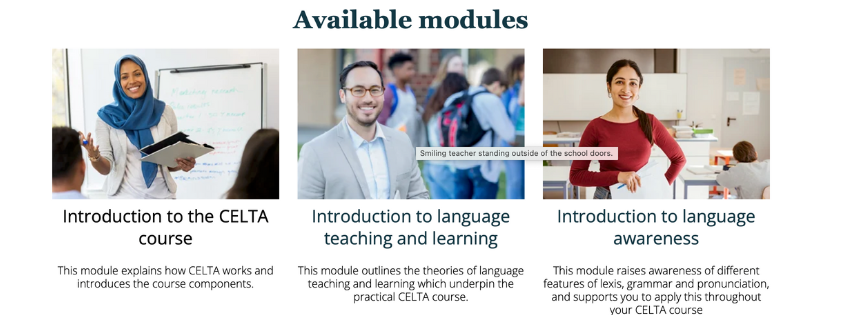
All you need to learn is taught during the CELTA itself! Still, if you feel there are gaps in your knowledge, Cambridge has created some material for your preparation.
Click on this link to be taken to a page where you can register freely and follow all the modules
The three modules can be completed at your own pace and in any order.
For those of you who have not yet registered on a CELTA course: A FREE preparation course offered by Cambridge. A great opportunity which every candidate can access completely free of charge
You do not need to pay for your preparation – the Cambridge CELTA preparation covers all the basic areas needed for CELTA candidates.
‘It is a truth universally acknowledged’ that some structures are more trouble to acquire than others. A classic example is the Present Simple, which, according to morpheme acquisition research is one of the last grammar structures to be acquired fully by foreign language learners.
In this article, written a very long time ago but recently updated, I have attempted to explore some of the possible causes of difficulty and offer some suggestions for an approach to introducing ‘difficult’ grammatical areas to foreign language learners. In order to do this, I have selected one such area and will use it in the discussion as a means to illustrate some of the issues involved in teaching and learning the grammar of English. The points I make should apply to other similarly ‘heavy’ areas of grammar.
Focus on the Present Perfect Simple
One of these ‘difficult’ grammatical areas that have caused language learners and teachers around the world quite a few headaches is the Present Perfect. Generations have sweated over it and yet, it still looms over the horizon like an ugly monster – a monster, moreover, not with one, but with quite a few heads!
The problems with this ‘tense’, it seems, are not in the area of understanding the rules of form or use. On the contrary, if you ask, say a group of intermediate students, who have been introduced to the different aspects and uses of the Present Perfect about rules, they will probably be quite capable of verbalizing them.
The same students will also be, in most cases, quite capable of dealing successfully with choices when they are given written exercises of the gap-fill type, or multiple choice type. Where things generally tend to break down is in the learners’ spoken as well as in their written production, in letters, summaries, reports and essays. It is with special emphasis on student free, unscripted production that I would like to re-examine a number of issues and offer some suggestions for classmates practices.
Let us first look at a number of student errors (collected from intermediate and post intermediate classes in Greece and compare them to the way the same meanings would be expressed in Greek. Teachers of learners of other nationalities need to list the equivalent in their learners’ language(s) and compare their error in a similar way to see if the learners are using their L1 (mother tongue) equivalent.
Greek Learner Errors
Greek Equivalent
I already done my homeworκ
Τελειωσα κιολας το διαβασμα μου/Εχω ηδη τελειωσει την εργασια μου.
I live in Chania for ten years
Μενω στα Χανια εδώ και δεκα χρονια.
Ιwork in a bank since last spring
Δουλευω σε τράπεζα από την περασμενη ανοιξη
I read only 10 pages until now
Μεχρι τωρα διαβασα/εχω διαβασει μονο 10 σελιδες
I didn’t never go to London.
Ποτε μου δεν πήγα/έχω παει στο Λονδίνο
Did you ever eat Chinese food?*
Εχεις φαει/εφαγες ποτε Κινεζικα φαγητα;
I didn’t finish yet.
Δεν εχω τελειωσει/τελειωσα ακομη.
Mother Tongue Interference
At first glance, mother tongue interference seems to be responsible for quite a few of them. If we contrast English with Greek, we can see that for most of the concepts/meanings expressed through the Present Perfect in English, in Greek there is a choice of three tenses – the Present Simple for utterances 2 and 3, and the Past Simple or Present for the rest of the examples, use of either of which in Greek is perfectly acceptable in spoken contexts. Apart, then for the morphological errors of utterances 1 and 5, the choice of tenses in most of the utterances indicates direct translation of concept and tense from the mother tongue, what linguists call mother tongue interference or negative transfer.
Moreover, when the choice of tense lies between Past and Present Perfect in Greek, learners seem to prefer the past. I do not think they do this in order to exasperate their teachers. The explanation may perhaps be that this is a tense more frequently used in spoken Greek and students, operating a simplification strategy to get their meaning across in English, use the same tense in English.
However, the mother tongue cannot always be held responsible as the only cause of learner difficulties. It often comes to the rescue of the learner when the forms , meanings, concepts and use have not been made clear to the student, have not been assimilated to the extent that the learner can retrieve and use them effortlessly and naturally.
We must also remember that, other things being equal, not all students learn when we want them to. Teaching does not equate with learning and the rate of assimilation varies from student to student.
Traditional teaching and its effects
The samples of student language displayed above were collected from a variety of classes taught by teachers faithful to the old rule and exercise teaching method, a method that still prevails even in many contemporary published materials. Having said this, there will be learners who will acquire no matter what. This post is not about this type of learner but for the rest of the student population which is, sadly, the majority.
The following checklist of questions may point out possible weaknesses in the way the various aspects and uses of this particular area of grammar were introduced and practiced.
Was the target language presented only through rules and abstract explanations?
Was it presented in context? (of a text or conversation)?
Was the context of the situation outlined clearly to the students?
Were the contexts natural and authentic, i.e. would native speakers have used the target language orally or in writing if placed in the same situation?
Were the students engaged in any activities where they were asked to notice the target language and work out the rules of use?
Were the concepts/meaning checked through questioning techniques that would reveal possible misunderstandings?
Was the structure contrasted meaningfully with others with which it might be easily confused?
Were the students ‘told’ about it or were they actively involved in discovering rules of meaning, form and use for themselves?
Were there enough opportunities for meaningful and personalized oral practice?
Did the students have the chance to use the structure in situations where they needed to communicate their own ideas, opinions, or feelings?
Were they involved in written tasks where native speakers would also use this language naturally?
Was the target language revised and reused in other contexts and situations?
Was the target language meaningfully contrasted with similar Greek/Italian/Chinese, etc., expressions to point out pitfalls?
Were there clear distinctions between forms usually encountered in spoken English vs. forms normally encountered in writing?
My checklist of questions implies a certain approach to teaching grammar for productive and communicative use. This does not mean that traditional ways of providing explanations when students are confused are to be avoided. It simply means that explanation is only one of the many tools available to the professional teacher but that it should not be the only way through which grammar is presented.
This checklist may also, hopefully, serve teachers as a reminder of creating the best possible conditions for learning and a tool for self-evaluation. Having fulfilled those conditions, however, does not ensure that all your students will learn, acquire or assimilate new material equally well at the same moment in time. Allowances must be made for those different learning rates as well as for different levels of ability within the same group of students. Frequent revision using a variety of activities and methods may be the best possible approach.
Selection & Grading Issues
One other reason why learners may be finding it difficult to use this tense correctly as part of their free oral or written production may also lie in the way teachers anxious and pressurized by the syllabus, very often push the whole thing together into one huge unpalatable and indigestible lump.
‘Today I’m going to teach the Present Perfect/ Passive Voice/ Conditionals’ is a statement I have often heard in teachers’ rooms. But which aspect? Which meaning? Which use? These are questions that are often ignored and many teachers attempt to present the sum total of the structure concentrating mainly on rules of formation and giving some general (but often vague) guidelines about meanings and uses.
Any of the ‘heavy’ structures mentioned in the previous paragraph would need to be spread over a number of lessons, and some uses/aspects would not even be introduced during the same year, but would be covered at a later stage or level.
It is not hard to see why students come away from grammar lessons of such ambitious aims with heads spinning with rules but not much else…
A sample lesson plan
To illustrate the points made through the questions checklist, I have included a lesson outline of an initial presentation of the Present Perfect Simple used with YET and ALREADY which is for use with elementary classes. This is not intended to portray the ideal lesson; it is simply a lesson that worked with a particular class. The context and activities included may have to be modified or replaced with others for different groups. This plan follows a simple PPP sequence – Presentation, Practice, Production – but a more experienced teacher could begin by getting the learners to produce the first conversation given some prompts and the context and follow a TBLT sequence.
You might like to check this lesson outline against the questions checklist presented earlier to see how far a different attitude to the teaching and learning og grammar makes a difference to materials and procedures we adopt in the classroom.
Comments on the lesson
What this 50 minute lesson includes that a ‘rules’ lesson does not:
Exposure to the new language item in a natural context which illustrates meaning, form and function.
Related skills development work; listening to spoken language in order to pick out information and the new language item as well as speaking skills development, both during the transfer stage where students have the opportunity to ‘apply’ and use the new items in an activity designed to promote fluency.
Attention to appropriacy, i.e. forms that are appropriate for use in the spoken medium. In the example given, question forms and short answers are those most frequently use by native speakers. Insistence on students’ producing full forms, fully completed sentences may result in a style of speaking which sounds bookish and ‘odd’ to the ears of the native speaker with whom our students will be eventually communicating.
Increased motivation: learning grammar ceases to be a dry and boring learning activity and becomes more interesting to the learner.
Active engagement of the learner’s cognitive abilities in a situation where s/he is involved in discovering meanings for her/himself and not ‘told’.
Conclusion
Mastery of a language implies mastery of the language systems. Many teachers, however, feel that this can only be done through teacher presentation and explanation of the rules that govern this language system. Research and classroom experience have shown the opposite. Knowing the rule, i.e. knowledge about the language, does not mean having the ability to use it fluently and appropriately when the time pressure of communicating with native speakers is on…
Reference
Dulay, Heidi & Burt, Marina. (1974). Natural Sequence in Child Second Language Acquisition. Language Learning. 24. 37 – 53. 10.1111/j.1467-1770.1974.tb00234.x.
About the Author
Marisa Constantinides is the Director of CELT Athens, a centre for teacher development. This is her main area of interest and apart from teaching on a variety of short courses, she is the supervisor for all Cambridge courses, CELTA and DELTA. She has written grammar practice materials for the young learner (Basic Grammar Workbooks 1, 2 & 3, English Schoolbook Publications) as well as activity material for literary texts in preparation for the FCE and CPE exams (Activity Books for ‘Selected Tales’ by D. H. Lawrence and for ‘The Go-between’ by L. P. Hartley). You can read more about her experience and publications here
LESSON OUTLINE
AIMS OF LESSON: To introduce & practise the Present Perfect Simple with YET and ALREADY
Level & Age of class: elementary learners 11-13 yrs
Forms: Have you polished the floor yet?
Yes, I have/No, I haven’t.
I’ve already done it.
N. B. ‘done’ is the only irregular participle which will be introduced. All the other verb forms be regular.
Meaning: Result in present
Function: Checking on jobs/duties done
Related Previous knowledge: The class is familiar with Present, Past (simple and continuous) and Future simple (all forms).
Context: A rich lady is checking whether various household chores have been done.
New lexis: mop, dust, polish, wash up (οr even better, none – elicit vocabulary familiar to the learners)
PROCEDURE
STAGE
ACTIVITY
MATERIALS
INTERACTION
TIME
1
WARM-UP
Elicit and write on the board some more chores e.g.
mop the floor dust the furniture
polish the floor wash up
cook dinner tidy up
wash the windows
etc. (all should be regular verbs)
Drawing
board
Class
pair
class
3’
4
2
PRESENTATION
Play or read a short conversation man/woman and cleaning lady or two flatmates. The context can be getting ready for a party or similar activity. Ask Ss to listen and say which of the chores on the board are mentioned (pre-question)
(conversation transcript)
A: Now, let me see.. Have you polished the floor yet?
B: Oh, yes, yes, I’ve already done it.
A: Looks great! OK! Check! Have you washed the dishes?
B: Mmm… yes, I have but I haven’t dried them yet.
Concept questions:
is it important when each job was done? (no)
What is important to her? (the result)
How does A know it’s done? (result can be seen; shiny floor, etc.)
tape
or
teacher
class
class
3’
2’
3
Focus on form:
T builds up substitution table on the board eliciting ideas from Ss
Have
I you we they
polished the floor yet?
Yes
No
I you we they
have
haven’t
Has
she
he
cooked dinner yet?
Yes, she
No,_she
’s already
hasn’t
cooked
done it cooked yet.
board
class
5′
4
Practice:
Ask Ss to continue the conversation using ideas from the chores list on the board.
Ss take roles and act out similar conversations.
The teacher orders various Ss to do things they have obviously already done. Ss respond using ALREADY, e.g.
Teacher: Helen, close your book. Helen: But I’ve already closed it, Miss.
More prompts:
do this exercise
open the window
take off your coat
close the door
hand me your homework
board
none
pairs
then class
3-4′
3-4′
3′
5
ROLEPLAY*:
A school director has asked the secretary to do a number of things and next day s/he checks on her/him.
A note like this can be written on the board or the jobs to be done can be elicited from the students and written up.
Please, remember to do these jobs by tomorrow:
type up the letters on my desk
telephone parents for the meeting
take the money to the bank
photocopy tests for B class
remind all teachers about parents’ meeting
*The context can be changed if you are teaching adults or the contents of the note can be changed – e.g. things to be done before a party or a business meeting, etc.
The role cards below be given to the ‘directors’ and the ‘secretaries’ separately to create an element of surprise.
SCHOOL DIRECTOR
You left a note to your secretary yesterday.
Check/See if she has done all the things you asked her to do. REMEMBER TO:
ask to see the result
if she has not done a job, ask WHY.
SCHOOL SECRETARY
Your boss left you a note. She always asks you to do too much anyway, so you did not have time to do everything!!
Decide which jobs you had time to finish. REMEMBER TO:
give her a report about jobs finished
explain why some jobs are NOT finished.
Be ready with a good excuse!
Handout or board
role cards
class
pairs
5’
10′
6
ERROR CORRECTION SLOT:
Feedback on errors noticed during roleplay
Remedial work, if needed
5-6′
Notes
The roleplay for this lesson was taken from Basic Grammar Wordbook 3, written by the same author.
You can do the roleplay without the rolecards – some of the surprise, however, will be lost!
This lesson can be adapted and used with minimum materials, e.g. just teacher and board. The nasty lady can be mimed or a quick stick figure drawing put on the board.
Many new CELTA holders, hundreds in fact each month, are out in the world looking for jobs! And since many of the courses are delivered fully online these days, it makes sense that our trainees will be looking for online work.
There is plenty of that about, but which online outfit to choose is a big question, one that our trainees often ask!
Martin Sketchley, an experienced colleague and trainer who has been working online for some time now, introduces us to the basics of how to set yourself up for online teaching; what microphone to use, what equipment, what lighting, and how to organise your working space. His advice is valuable to new online teachers.
Other colleagues share advice on how to find students and some, share ideas about websites useful to the online teacher for activities and materials you can use either for free or at very low cost to save on preparation time.
Online outfits
This post does not aim to tell you which online outfit is the best but to list a number of sources of information which you can use in order to judge where to apply and to have an idea of whether your application will be considered or not. For example, is it a good idea to apply if you do not have a first degree or not? Some outfits insist on this, other outfits are happy if you just have a CELTA.
A walkthrough of 28 sites
You can find a great list of more than 25 sites on You Tube under this highly informative video
Some Posts evaluating different online spaces
Οn Kate & Kris’ blog, have a look at this blog post which contains reviews from a variety of teachers.
All these sites have been reviewed – we have started this for you. Use google and You Tube searches to find information about each one – add the link in a comment if you can.
Oral exams are a part of every official language assessment.
In an effort to boost students’ confidence and ensure top-notch performance, teachers commonly teach students tricks to “impress” the examiner.
No need to impress
A fluent speaker does not really need to “impress” anyone. The more we seek to convince our students that they need to impress an oral examiner, the more stress we put on them and the more unnatural they end up sounding.
Oftentimes, teachers introduce set phrases such as
“I subscribe to the belief that” “It is my firm belief that”
They also advise their students to always begin whatever they say with one of them when being interviewed in oral exams.
These expressions may be effective in an official debate or discussion, but they sound really odd in other situations and actually produce the opposite result: students think they have to start every single answer using a particular expression; as a result, in a series of questions posed by the examiner, this pattern becomes repetitive and they come across as being rather robotic and really very odd!
So, instead, teaching them ways of sounding natural and phrases that they can use when acknowledging an opinion, interrupting politely and fillers and time gaining devices such as “well”, “so”, “right”, “anyway”, will definitely make them more effective speakers both for exams and face-to face communication.
It is not only a matter of teaching, however.
Speaking as much English as possible in class also proves vital as students are “forced” to use spoken language forms and experiment freely in a friendly and supportive environment, especially if they live in a country where English is not spoken as a first or second language.
They already know
It is quite evident nowadays that the unprecedented rise of technology helps younger learners become more aware of everyday talk and what they need to use when speaking.
My younger Greek students – ages 8 to 12 – already use discourse markers (especially “well“), mainly because of their exposure to authentic materials from YouTube, Instagram, TikTok and other similar online platforms or sites. This shows not only how helpful this input is for their language skills but also another significant aspect: they notice.
They might be watching a video game walkthrough, an interview of a famous person or even how to apply make-up effectively. But still, they notice these subtle language patterns and manage to incorporate them into their output quite effectively. In this case, laying emphasis on discourse markers will further strengthen their proper use, making their use become a second nature to our learners.
Let them choose
It makes sense then that bringing authentic materials to class is key in teaching them how to become natural speakers.
Find out their interests will definitely bring what they follow at home, in class (with due caution, of course, regarding age and permitted content for their age). Vlogs, videos and other similar sources can assist in both focusing on the content of the material and on noticing language patterns in the speakers’ speech and use of language per se.
The focus may vary, depending on the aim of a course and the age of the students – teaching a businessman how to present, negotiate or persuade is certainly very different from a teenager chatting to other youngsters during an online game.
Creating a fun presentation for instagram or TikTok, for instance, could be one of the main aims of a lesson which will result in higher levels of motivation and turn learning into a fun process based on what students really enjoy.
After all, we all want our students to become as fluent as possible rather than condemn them to using a style of speech that will cause them to be judged as odd, bookish, or even affected by the average L1 user or their L1 peers, so it is really worth the effort.
In this post, I will be looking at the last few steps in the selection process for a CELTA course. To reach that stage, you will have completed and sent an application form back to your chosen centre, and you will have received or downloaded their pre-interview task to complete either over a number of days or under timed conditions.
After receiving your completed pre-interview task answers, a CELTA tutor will contact you to invite you to attend a personal interview.
If unable to attend a face-to-face, which is quite common if you are applying for an in person course, your interview will usually be held over Skype, Zoom, or other similar messenger.
Online interviews have more or less now become the norm of course, but in future, in-person interviews where possible, may come back!
MESSENGERS & SKYPE
It is sometimes much more convenient (and economical for the candidate) to be interviewed via Zoom, Skype or other online meeting room using voice and a webcam. Telephone conversations are fine but being able to have face contact with your interviewer may alleviate a lot of anxiety.
This is a much better solution because it is always more confortable and useful, for both interviewer and interviewee, to be able to see each other.
QUESTIONS YOU WILL BE ASKED
Different centres follow different scenarios in their interviews but what they need to find out about you during the interview is not just what you have written in your application form or CV.
Your interviewer may wish to doublecheck all or some of the following – whether you are a native or non-native speaker of English:
that your knowledge of grammar and vocabulary is in place
that your spoken English is at a high enough level
that you have good interpersonal communication skills
that you have a good awareness of the demands of the course
that you are not going through a difficult time in your life which might prevent you from being successful on the course
that you are open to learning and amenable to criticism as the course is high on critique of one’s teaching
that you are well-organised and disciplined
that you do not have any biases which might prevent you from offering equal opportunities to your learners
Your interviewer – who will usually be a CELTA tutor – will also give you a lot of information about the course, the number of assignments, teaching practices, about the workload and the resources available.
Feel free to ask any questions which will help you understand how to organise your study time so that you can maximise your chances of success.
At some point during the interview, some centres might also ask you to do a quick writing task – something related to language or teaching which should take no longer than 10-15 minutes. This might be done in order to see if you can express yourself clearly, correctly and fluently when you have to write under pressure as some centres will not time you while doing the pre-interview task.
Above all, the interviewer will want to see if you
are aware that teaching is a demanding profession,
have very high or very low expectations of yourself,
have the kind of personality that will allow you work well with others in your group (trainees collaborate in Teaching Practice groups)
have an understanding of what it takes to be a teacher.
So, all in all, being accepted on a CELTA course can be a great thing but if you are not accepted, this will usually be done because the interviewer believes that at this particular stage, your chances of being a successful candidate are not very high – which not a bad thing, as following a CELTA course involves a great commitment of time, money and personal work during course hours and after hours too!
Having an idea of what it is that centres look for may help you prepare better and be accepted next time round.






















 The Cambridge CELTA